
"We do not really need a website, we get everything through Facebook." We hear this often, and it is never coming from someone unreasonable. It is coming from someone whose page genuinely is producing work, who has watched competitors spend money on sites that produce nothing, and who has drawn the obvious conclusion.
The conclusion is half right. A social page is an excellent front door. The problem is that it is a bad house, and the difference matters more as the business grows.
What a social page genuinely does well
Worth being fair about this first, because the advice usually is not. A Facebook or Instagram page gives you distribution you do not have to earn from scratch, a low-effort way to show recent work, social proof that reads as real because it is attached to real accounts, and a messaging channel people already have open. For a business that sells on personality and recent work — a barber, a bakery, a builder with good photos — that is a real asset.
None of what follows argues for abandoning it. It argues for not relying on it alone.
You do not own it
This is the one that costs people the most and gets thought about the least. The page is not yours. It sits on a platform that can change what it shows, change what it charges, restrict the account, or suspend it — sometimes by mistake, sometimes with no explanation and no one to call.
If that happens, you do not just lose the page. You lose the followers, the review history, the message threads and the only route your customers know. Businesses that have been through it describe it the same way every time: it is not the lost posts, it is discovering the whole customer relationship was rented.
A website you own cannot be switched off by someone else. That is the entire argument, and it is enough on its own.
It does not answer the questions buyers actually have
Someone deciding whether to call you has a specific and boring list of questions. Do you cover my area? What does it roughly cost? How soon can you come? Have you done this exact thing before? Are you insured, licensed, qualified?
A feed is chronological, which is precisely the wrong shape for that. The answers might be there, scattered across eight months of posts and a comment thread. A visitor will not go looking. They will message you and wait, or — far more often — they will go to whoever answered the question on a page.
This is the same failure that loses people on badly built websites too, which is worth reading about separately: five reasons customers leave without calling.
It does not show up in search the way you think
Social pages do appear in search results, usually when someone searches your business by name. That is the easy case — those people already know you exist.
The valuable searches are the ones where nobody knows your name yet, the "someone near me who does this thing" searches. Those are contested by pages built to answer that specific question, and a feed is not competing for them. You cannot give a post a title, a description, or a clear subject and expect it to rank the way a page can.
It flattens you into the same template as everyone else
Every page on a social platform has the same layout, the same fonts, the same shape. Your header photo and your writing are the only things distinguishing you from your competitor, whose page is also a header photo and some writing.
If you are competing on being the most established, most careful or most premium option, that is a bad trade. Looking substantial is most of how people decide who to trust before they have met you — which is what branding actually does.
You cannot measure much, and you cannot fix what you cannot measure
Platform analytics tell you about reach, likes and follows. What they cannot tell you is which of those turned into a customer. So the loop that makes marketing improve over time — try, measure, adjust — never closes. You are left guessing which posts worked, which is how businesses end up spending years on content that was never producing anything.
The "I will just use Instagram" version
Everything above applies, plus one extra: a single link. Every question a visitor might have has to route through one URL and a profile bio measured in characters. That is a very narrow gate for a business with four services and three service areas.
What the minimum actually looks like
The answer is not a large website. For most businesses saying "we just use Facebook", the useful minimum is small:
- One page per thing you actually sell, so each can be found on its own
- The boring answers written down: areas covered, rough pricing, availability, credentials
- Proof — real work, real reviews, real faces
- A phone number that is visible without scrolling, and one form that works
- A domain and hosting account in your own name
That is a modest build. It also gives you something no platform can take away, and something the social page can finally point at.
Use both — but own the middle
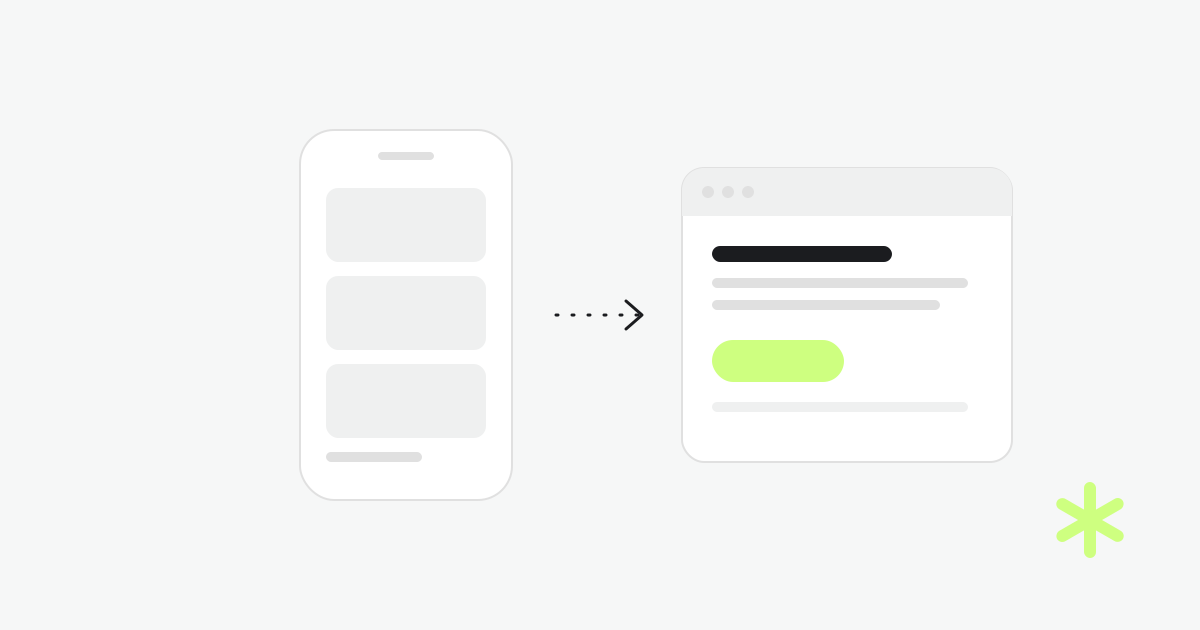
The strongest setup for a local business is not one or the other. Social is where people find you and get a feel for whether they like you. The site is where they get their questions answered and decide. Social does the introducing; the site does the converting.
Keep posting. Just stop letting the only copy of your customer relationship live on someone else’s server. If you want to know what that minimum would look like for your business, book a free call and we will tell you what we would and would not build.
Written by Coltera



 No Pressure
 15-30 min. call
 Clear next steps