
Ask three agencies what a website costs and you will get three different numbers, none of which explain themselves. One quote is a few hundred. One is a few thousand. One arrives as a monthly figure with a long commitment attached. The work sounds identical in all three.
It is not identical. The gap is real, and it comes from a small number of decisions that are easy to spot once you know where to look. This is what actually moves the number.
You are mostly paying for scope, not for design
Almost everyone assumes the price reflects how the site looks. Visual design is a genuine cost, but it is rarely what separates a cheap quote from an expensive one. What separates them is how much the site has to do.
A site that explains your services and gives people a way to get in touch is a fundamentally simpler build than one that takes bookings, holds customer accounts, processes payments or talks to software you already run. Each of those adds pages, states to handle, things that can fail, and testing to prove they do not. That is where the hours go.
The honest shorthand: count the things a visitor can do on the site. If the answer is "read, and then call or fill in a form", you are at the simple end no matter how good it looks.
The five questions that set the price
Whatever the quote looks like, it is answering these underneath:
- How many genuinely different page layouts there are — five pages that share one layout is one design job, not five
- Whether anything is interactive: booking, quoting, accounts, payments, member areas
- Who writes the words. Copy is the most commonly underestimated line in any website project
- Whether a brand already exists, or has to be created before the site can be designed
- Whether the site has to connect to something you already use — a CRM, a booking tool, an inventory system
Two quotes that differ by a factor of five usually differ on three of those five points. If you cannot tell which, the quote is not detailed enough.
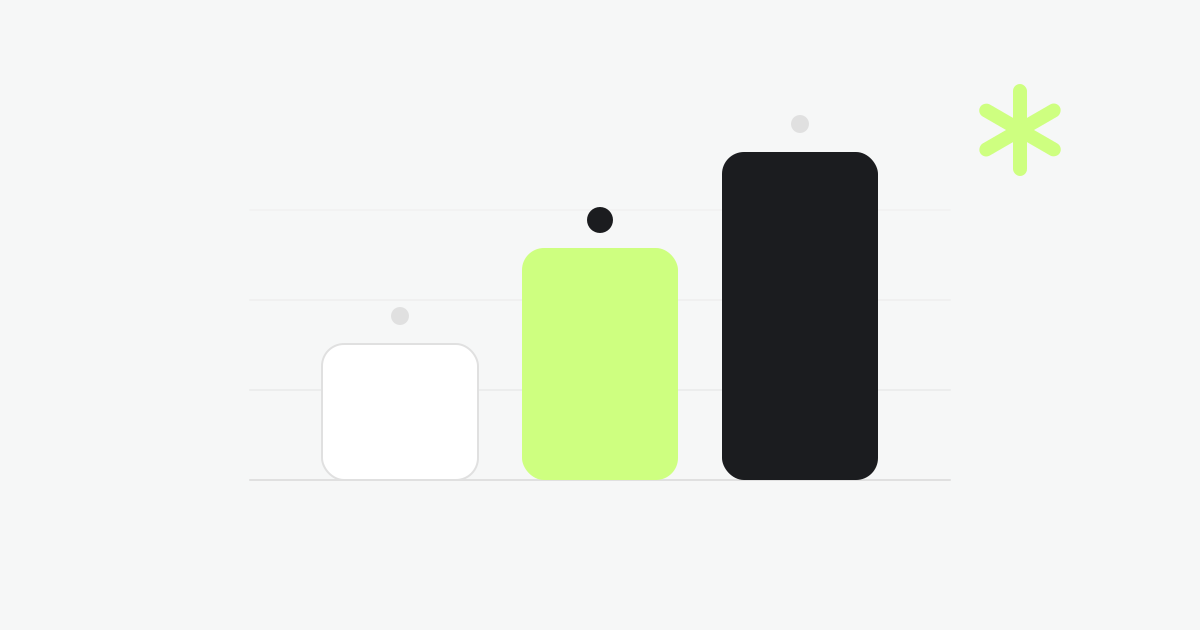
The three bands, roughly
At the bottom sits a template you assemble yourself on a site builder. The software cost is small and the work is yours. This is a genuinely reasonable option for a business that needs to exist online this week and has someone willing to do the assembling. What you give up is the ability to make it fit — you get what the template does, and you work around what it does not.
In the middle sits a custom-designed site of modest size: your services, your proof, your contact routes, built around how customers actually decide. This is where most local businesses land, and where the return is usually clearest, because the whole thing is shaped around getting one specific action to happen more often.
At the top sits anything with a system behind it — real booking, e-commerce, accounts, integrations. The design effort may be similar to the middle band; the build and testing effort is not close.
We scope every build up front rather than quoting from a price list, for the plain reason that the five questions above have different answers for every business. You can see how we work through that on the portfolio.
Where the money quietly goes after launch
A website is not a one-off purchase in quite the way it is usually sold. Some costs continue whatever you do: the domain, hosting, and the occasional fix when a browser or a plugin changes underneath you. Those are small but they are not zero.
The larger ongoing question is whether anyone is improving the thing. A site that launches and is never touched again slowly drifts out of date — old prices, a service you no longer offer, a photo of a van you sold. That drift costs you more than hosting ever will.
Five questions to ask before you sign anything
- What exactly is in scope, written down? "A website" is not a scope
- Who writes the copy, and is that included?
- Do I own the domain, the hosting account and the files? The answer should be an immediate yes
- What happens if I want to change something myself in six months?
- What is the ongoing cost, and what does it actually cover?
If a quote cannot survive those five questions, the problem is not the price. It is that nobody has agreed what is being built.
The cheapest option is rarely the cheapest
This is not an argument for spending more. Plenty of businesses are well served by something modest, and an expensive site that nobody can find is worse than a cheap one that answers the phone.
But the failure mode of the cheap option is specific and worth naming: you pay once, it does not bring in work, and eighteen months later you pay again to do it properly. The total is higher than doing it once, and you have lost a year and a half of enquiries in between.
The useful question is not "what does a website cost". It is "what would one more customer a month be worth to me", and then whether the quote in front of you is plausibly going to produce that. If it is, the number is usually easy. If it is not, no price is low enough.
If you want a straight answer for your situation, that is exactly what our free call is for — and if the honest answer is that you do not need us yet, we will say so.
Written by Coltera


 No Pressure
 15-30 min. call
 Clear next steps